From Inquiry to Enrollment: A Lead-Follow-Up System for Tutoring Businesses


From Inquiry to Enrollment: A Lead-Follow-Up System for Tutoring Businesses
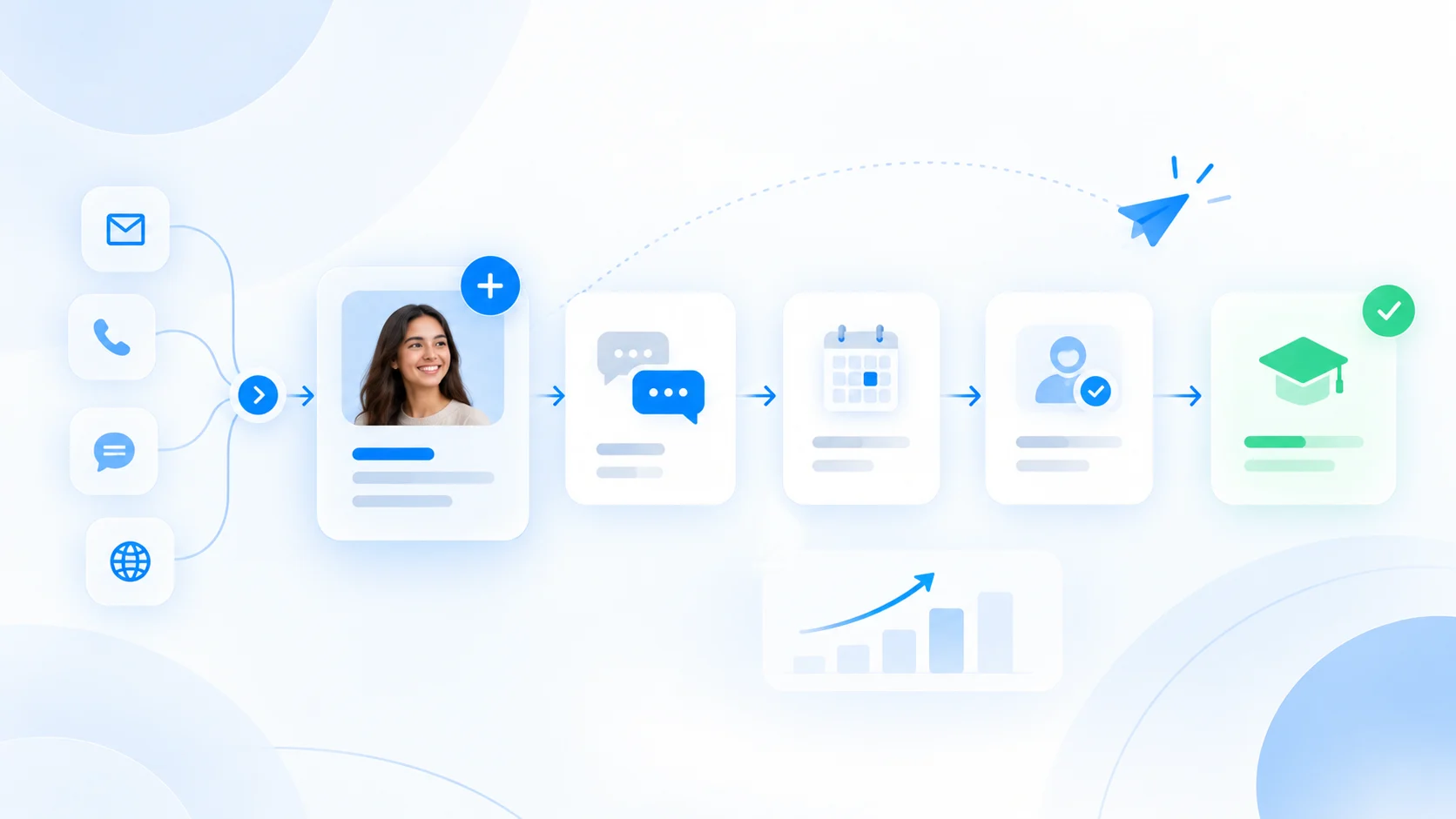
Most tutoring businesses do not lose leads because nobody cares. They lose them because ownership is unclear, the next action lives in someone’s memory, and the company cannot tell the difference between “interested,” “waiting,” and “gone.” A lead-follow-up system fixes that by giving every inquiry a stage, an owner, a next action, and a date.
Start with one pipeline, not five inboxes
Website forms, referrals, phone calls, social messages, school partnerships, and email inquiries should all end up in one operating record. The source can remain visible for attribution, but the follow-up workflow should not depend on remembering where the conversation started.
Use stages that describe reality
Stage | Definition | Required next action |
New inquiry | Contact received; no meaningful conversation yet | First response |
Contacted | Response sent or call attempted | Follow-up date |
Qualified | Need, student, subject, timing, and fit understood | Consultation/demo |
Consultation complete | Conversation happened | Proposal or decision follow-up |
Decision pending | Family has information needed | Specific check-in date |
Enrolled | Payment/registration/first lesson confirmed | Onboarding |
Nurture | Valid lead, not ready now | Future trigger/date |
Closed | No fit, chose another option, or explicitly declined | Reason recorded |
Every open lead needs a next action
The simplest CRM rule is also the most powerful: an open lead should never exist without a next action and next-action date. “Follow up” is not enough. Write the action as a verb: call parent Tuesday at 4 p.m.; send diagnostic options; confirm tutor availability; ask whether the family wants the Wednesday slot.
Separate speed from pressure
Fast response matters because families often contact several providers, but speed should not become aggressive messaging. The goal is to reduce uncertainty. A strong first response confirms the request, shows that a real person understands it, asks the minimum questions needed to route the lead, and makes the next step easy.
A useful first-response checklist
Student grade/age and subject or test
Primary goal or problem
Target timeline or exam date
Preferred schedule and delivery format
Whether a diagnostic or consultation is needed
Clear next step with available options
Build a follow-up cadence around decisions
Do not send the same “just checking in” email repeatedly. Each follow-up should help the family make a decision: clarify tutor fit, explain the plan, offer schedule options, answer a concern, or close the loop. If there is no response after a reasonable cadence, move the lead to nurture rather than leaving it indefinitely in an active stage.
Moment | Purpose | Example action |
Immediately | Acknowledge and route | Confirm need + propose next step |
1–2 business days | Reduce unanswered questions | Share tutor/plan options |
After consultation | Make decision concrete | Send summary + recommendation |
Before promised decision date | Respect agreed timing | Short targeted check-in |
No decision | Protect pipeline hygiene | Move to nurture with future trigger |
Measure the pipeline by stage, source, and reason
Owners should know more than the total number of inquiries. Track conversion from inquiry to consultation, consultation to enrollment, time spent in each stage, lead source, reasons for loss, and the number of leads with overdue next actions. These metrics reveal whether the problem is lead volume, response discipline, qualification, pricing, tutor availability, or the sales conversation itself.
Connect sales to operations before promising anything
A CRM should not operate in isolation from scheduling and service capacity. Before offering a family a tutor or time, confirm that the capacity exists. This is especially important in high-demand after-school windows. Selling a slot the business cannot reliably staff creates an operations problem at the exact moment a new customer is forming an opinion.
Create a weekly pipeline review
Review every lead with an overdue next action.
Check leads stuck unusually long in one stage.
Compare new inquiries with consultations and enrollments.
Review lost reasons and capacity constraints.
Assign concrete actions for the next seven days.
Define ownership rules for shared teams
As a tutoring company grows, leads often touch several people: an administrator answers the form, an academic director assesses fit, an owner handles pricing, and a tutor may join the consultation. Without explicit ownership, everyone can assume someone else is following up. The CRM should therefore show one accountable owner at every stage, even when several people collaborate.
Ownership can change as the lead advances. An intake coordinator may own New and Contacted leads, while an academic manager owns Qualified and Consultation Complete. The important point is that the handoff is deliberate, timestamped, and accompanied by the next action. A lead should never become ownerless during a transition.
Capture qualification without turning intake into an interrogation
The company needs enough information to recommend the right service, but families should not have to complete a twenty-field questionnaire before speaking to someone. Capture the minimum information needed to route the inquiry, then deepen qualification during the conversation. This reduces friction while preserving useful data.
For tutoring, high-value qualification fields often include student grade, subject or test, current challenge, goal, timing, preferred schedule, location or online preference, and any hard constraints. For test prep, add target test date and recent score information when available. The goal is not data collection for its own sake; every field should change routing, recommendation, or follow-up.
Create lost-reason categories you can act on
Closed-lost leads are valuable only when the reason is specific. “Not interested” hides the difference between price, schedule, tutor fit, no response, delayed need, chose a competitor, solved internally, or not a service the company provides. Use a small standardized set of reasons and allow a note for context.
Review these reasons monthly. If schedule is the dominant loss reason, the problem may be tutor capacity rather than sales. If families repeatedly stop after pricing, the company may need better positioning, packaging, or qualification. If many leads go silent before a consultation, response speed and cadence deserve attention.
Connect marketing attribution to actual enrollment
A lead source is useful only when it survives through the pipeline. Track whether inquiries came from referrals, organic search, paid campaigns, school partnerships, webinars, social media, or other channels, and compare each source by qualified-lead rate and enrollment rate—not just inquiry count. A source that generates fewer but better-fit families may be more valuable than a high-volume source that rarely converts.
For small tutoring businesses, this does not require sophisticated attribution software. Consistent source fields, stage definitions, and enrollment outcomes are enough to make better decisions about where to spend time and money.
Automate reminders, not relationships
Automation is useful for creating tasks, reminding owners about overdue follow-ups, confirming consultations, and moving stale leads into review queues. It should not replace context. Families can tell when they receive repetitive messages that ignore the conversation. Use automation to protect process discipline while keeping the actual communication specific to the student and family.
A 30-day implementation checklist
In week one, define the pipeline stages and require an owner, next action, and next-action date for every open lead. In week two, clean up stale opportunities and standardize lost reasons. In week three, connect lead source and tutor availability to the enrollment record. In week four, review conversion by stage and identify the single biggest leak in the pipeline. Fix that leak before adding more automation or more fields. A small tutoring company can run an excellent sales process with a simple CRM if the data is current and the rules are consistent. The operating discipline matters more than the number of dashboards: capture the inquiry, understand the need, make the next step clear, and close the loop.
Document the rules in one short operating guide so a new team member can understand the pipeline without learning it through trial and error. Consistency is what makes the reporting trustworthy.
Bottom line
A tutoring sales pipeline should make follow-up boring in the best possible way. Every inquiry is captured, every open lead has an owner, every owner has a next action, and every stage has a definition. That structure gives families a cleaner experience and gives managers the data to improve enrollment without relying on memory or heroic follow-up.
Other Stories