SAT Educator Question Bank: A Tutor Workflow | Evallo


SAT Educator Question Bank: How Tutors Can Build Better Practice Sets
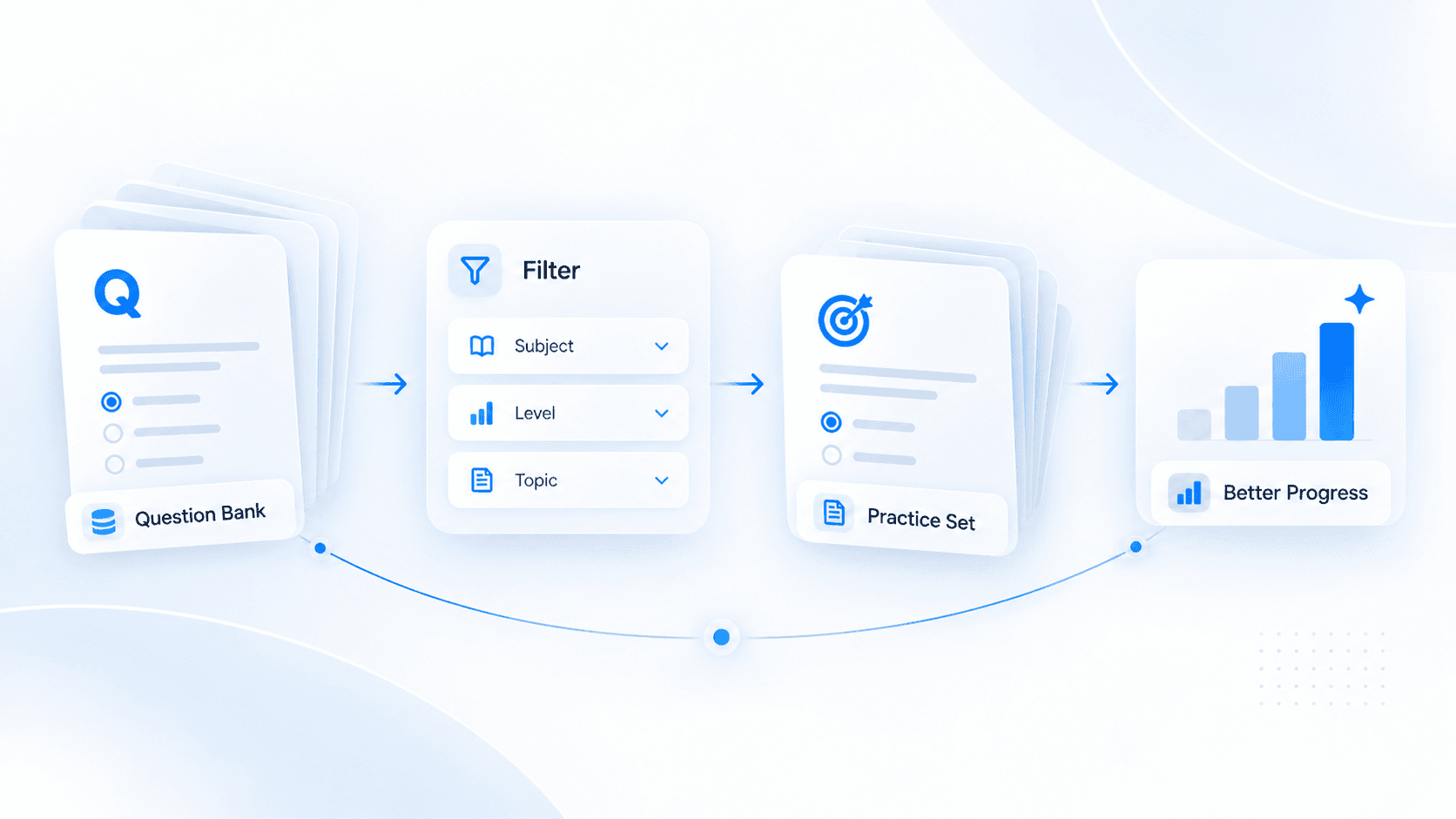
The SAT Educator Question Bank is most useful when tutors treat it as a precision tool, not a giant worksheet generator. College Board says the bank contains thousands of SAT Suite questions and lets educators filter by assessment, test section, domain, and other criteria, then view or export selected prompts and answer rationales. The practical opportunity is straightforward: start with evidence about what a student needs, filter deliberately, and build a small practice set that tests one instructional hypothesis at a time. College Board’s Educator Question Bank overview
What is the SAT Educator Question Bank?
College Board’s Educator Question Bank (EQB) is an official repository of questions from the SAT Suite of Assessments. College Board states that educators can search questions created by the test maker, filter them to create targeted sets, and view or export selected question prompts and answer rationales. The overview also notes that the public EQB can be used without signing in.
That makes the EQB valuable for tutors who need official examples for instruction, homework, mini-assessments, or error-specific remediation without consuming another full-length Bluebook test.
The key principle: diagnose first, filter second
A question bank becomes inefficient when the tutor begins with the bank instead of the student. “Do 20 hard Math questions” sounds rigorous, but it may mix several domains and error mechanisms. A better workflow begins with a specific finding: for example, the student repeatedly mis-translates nonlinear relationships, or misses inference questions when the correct answer requires a narrow textual claim.
Once the instructional target is clear, the bank becomes a search layer. The tutor is no longer asking “What can I assign?” but “What evidence would show whether this skill is improving?”
A 5-step SAT question-bank workflow for tutors
1. Define the skill gap
Write the gap in observable terms. Avoid labels such as “weak at Reading” or “bad at Algebra.” Name the domain, skill, and recurring failure mode.
2. Choose the right section and domain
Filter broadly enough to stay aligned with the test blueprint, but narrowly enough that the resulting set measures the intended skill.
3. Filter by skill and difficulty
Use difficulty deliberately. Easier items can isolate whether the student understands the core idea; harder items can test transfer, efficiency, and resistance to distractors.
4. Build a short set with a purpose
A focused 6–12 question set can often tell a tutor more than a large mixed worksheet because the results are easier to interpret.
5. Review the error mechanism, then decide what comes next
Do not automatically assign another set. Decide whether the miss came from knowledge, recognition, process, reading, execution, timing, or decision-making.
How to use EQB filters without creating random practice
Filter | Use it to answer | Tutor caution |
|---|---|---|
Assessment / section | Which test and section are we actually training? | Do not mix formats simply to create more volume. |
Domain | Where is the broad content weakness? | A weak domain can still contain strong and weak individual skills. |
Skill | Which repeatable task should the student practice? | Keep the set interpretable; too many skills obscure the result. |
Difficulty | Is the student building the foundation or testing transfer? | Harder is not automatically better. |
Question selection | Which items best test the current hypothesis? | Avoid selecting questions only because they look unfamiliar or difficult. |
Use the question bank as formative assessment, not just homework
College Board explicitly suggests using EQB questions as short formative assessments and classroom routines. Its sample question-bank activities include Question of the Day-style use and short activities designed to focus student thinking. For a tutor, that same principle can be adapted to one-on-one instruction.
Open a session with one diagnostic question before reteaching a topic.
Use three questions at increasing difficulty to see where the student’s process breaks.
Ask the student to explain why each wrong option is wrong, not only why the correct option works.
End a lesson with a fresh question that tests transfer without announcing the skill in advance.
Use a short mixed set a week later to test retention rather than immediate familiarity.
Connect practice-test evidence to targeted questions
The strongest use of a question bank begins with clean diagnostic evidence. After a Bluebook practice test, My Practice lets students review every question and download a practice score report that includes performance across content domains. College Board also provides tailored practice based on practice-test performance. A tutor can use those signals to decide which domains and skills deserve focused work.
College Board’s Bluebook practice guidance specifically recommends reviewing missed questions, noticing patterns in content and skills, and then using the Student Question Bank for additional practice. The tutor’s added value is the interpretation layer: deciding which pattern matters, why it exists, and what sequence of practice is most likely to change it.
Do not confuse question volume with instructional quality
A large question bank can create a subtle trap: because material is available, tutors feel pressure to assign more of it. But the scarce resource is not questions. It is student attention and tutor interpretation.
Ten well-chosen questions with a clear review protocol can produce more useful evidence than 40 loosely related questions. The best assignment is one where the tutor already knows what different result patterns would imply for the next lesson.
A practical assignment-design template
Field | What to record |
|---|---|
Diagnostic evidence | What result or observed behavior triggered this assignment? |
Target domain / skill | What exactly should improve? |
Error hypothesis | Why is the student currently missing these questions? |
Question selection | Which section, domain, skill, and difficulty filters were used? |
Set size | How many questions are needed to produce interpretable evidence? |
Review rule | What will the tutor examine besides percent correct? |
Next decision | What result would trigger reteaching, harder practice, mixed practice, or retesting? |
How tutoring businesses can make targeted practice repeatable
For a solo tutor, this workflow can live in session notes. For a team, it needs enough structure that another tutor can understand why a set was assigned and what happened afterward. Standardize the language for domains, skills, error causes, and follow-up decisions. That makes student progress easier to compare across sessions and reduces the chance that each tutor rebuilds the same workflow independently.
If your team wants testing, assignment delivery, grading, and analytics in one operating workflow, Evallo Prepwork supports digital SAT and ACT practice, custom assignments, score reports, and progress analytics. The broader point is not to replace official material: it is to connect assessment evidence to the next instructional action.
Evallo’s Digital SAT overview is also useful background for teams still adapting older materials to the current digital, adaptive SAT structure, while the Evallo educator community maintains a shared-resources focus for tutors and education professionals.
When should tutors use a full practice test instead?
Use a full-length practice test when you need evidence about transfer across mixed content, adaptive-module performance, pacing, endurance, or overall score movement. Use a targeted question set when you already know the likely weakness and need to teach, isolate, or retest a smaller skill.
College Board continues to provide scored full-length digital practice tests in Bluebook. Those tests are better treated as diagnostic checkpoints than as an unlimited homework supply. Targeted question-bank work can fill the instructional space between those checkpoints.
SAT Educator Question Bank FAQ
Does the Educator Question Bank require a College Board account?
College Board says the public Educator Question Bank can be used without signing in. Some K–12 reporting workflows require appropriate portal access.
Can tutors filter official SAT questions by skill?
College Board’s question-bank tools support targeted filtering. The Student Question Bank explicitly lists assessment, test, domain, skill, and difficulty filters; the Educator Question Bank supports assessment, section, domain, and additional criteria.
How many questions should be in a targeted SAT practice set?
There is no universal ideal. Use enough questions to observe a pattern without mixing so many skills that the result becomes difficult to interpret. For many tutoring decisions, a short set is more diagnostic than a large worksheet.
Should tutors use only hard questions for high-scoring students?
No. Difficulty should match the diagnostic purpose. Easier and medium questions can reveal whether a foundation is stable; harder questions are useful when testing transfer, efficiency, and resistance to sophisticated distractors.
What should happen after a targeted set?
Classify the misses, compare them with the original hypothesis, and choose the next action: reteach, repeat at the same level, increase difficulty, mix the skill with others, or validate the change in a timed/full-test setting.
The bottom line
The SAT Educator Question Bank is powerful because it gives tutors access to a large pool of official material. But the educational advantage does not come from the size of the bank. It comes from precision: choosing questions that answer a specific instructional question, reviewing why the student responded as they did, and letting the result determine what happens next.
Other Stories