SAT Practice Test Analysis: A Tutor Framework | Evallo



SAT Practice Test Analysis: What Tutors Should Track After Every Mock Test
An SAT practice test is most useful when the score is treated as the beginning of the analysis, not the conclusion. For tutors, the real diagnostic value comes from identifying which domains are weak, why errors are happening, whether timing is distorting performance, and what the student should practice next. College Board’s own Bluebook guidance follows the same basic logic: review scores, inspect missed questions and their associated domains, then use targeted practice to address the skills that need work.
What should tutors analyze after an SAT practice test?
A useful post-test review should answer five questions: What changed in the score? Which content domains are driving the result? Which specific skills are producing repeated misses? Is pacing causing avoidable errors? And what should the next one to two weeks of practice actually contain?
Score trend: total and section scores across multiple comparable practice tests.
Domain performance: Reading and Writing and Math performance at the domain level.
Skill-level errors: the recurring question types or concepts behind incorrect answers.
Timing and decision-making: rushed guesses, unfinished work, excessive time spent on individual items, and preventable second-guessing.
Next-step practice: a small, explicit set of skills and question types to prioritize before the next full-length test.
1. Start with the score trend—but do not stop there
The total score is useful because it gives the tutor a common outcome metric. But a single score is noisy. Difficulty mix, concentration, sleep, pacing, and normal variation can all affect one sitting. The better question is whether a pattern is forming across multiple tests.
Track the total score and the two section scores over time, but annotate each test with context: Was it taken under realistic timing? Were there interruptions? Was the student already familiar with some questions? A score trend without testing context can create false confidence or unnecessary alarm.
2. Read the domain data as a teaching map
College Board’s My Practice score reports summarize practice-test performance and include performance across content domains. That is more actionable for a tutor than a total score alone because it helps localize the problem.
Signal | Tutor question | Likely action |
|---|---|---|
Weak domain | Is the weakness broad or driven by one recurring skill? | Review missed items, then isolate the skill before assigning more volume. |
Strong domain, low section score | Is another domain or pacing issue suppressing the section? | Protect the strength; redirect practice time. |
Uneven performance across tests | Is the skill unstable or is test behavior changing? | Compare error type and timing before reteaching content. |
3. Build an error taxonomy instead of an error log
Many students keep a list of missed questions. That is better than nothing, but it often becomes an archive rather than a learning system. A tutor should classify errors by cause so that repeated patterns become visible.
Knowledge gap — the student did not know the underlying concept or rule.
Recognition gap — the student knew the concept but did not recognize that it applied.
Process error — the approach was inefficient, incomplete, or poorly sequenced.
Reading error — a condition, qualifier, transition, unit, or relationship was misread.
Execution error — arithmetic, algebra, transcription, or calculator use caused the miss.
Timing error — the student rushed, guessed, or abandoned an item because of pacing.
Decision error — the student changed a correct answer without sufficient evidence or chose an attractive distractor despite contradictory evidence.
Why the cause matters
Two students can miss the same algebra question for completely different reasons. One may not understand exponential models; another may understand the model but misread what the question asks for. Giving both students the same ten algebra questions treats the visible symptom rather than the underlying cause.
4. Separate content weakness from pacing weakness
A student who performs accurately when untimed but deteriorates late in a module has a different problem from a student who misses the same skill even with generous time. Tutors should therefore note where in the module errors occur, whether questions were attempted, and whether time pressure changed the student’s method.
A simple pacing audit
Mark questions that consumed disproportionate time.
Identify clusters of late-module guesses or omissions.
Compare accuracy before and after the point where pacing deteriorated.
Check whether the student is overinvesting time in difficult questions at the expense of easier points.
Retest the same skill under controlled timing before concluding that content mastery is weak.
5. Turn analysis into targeted SAT practice
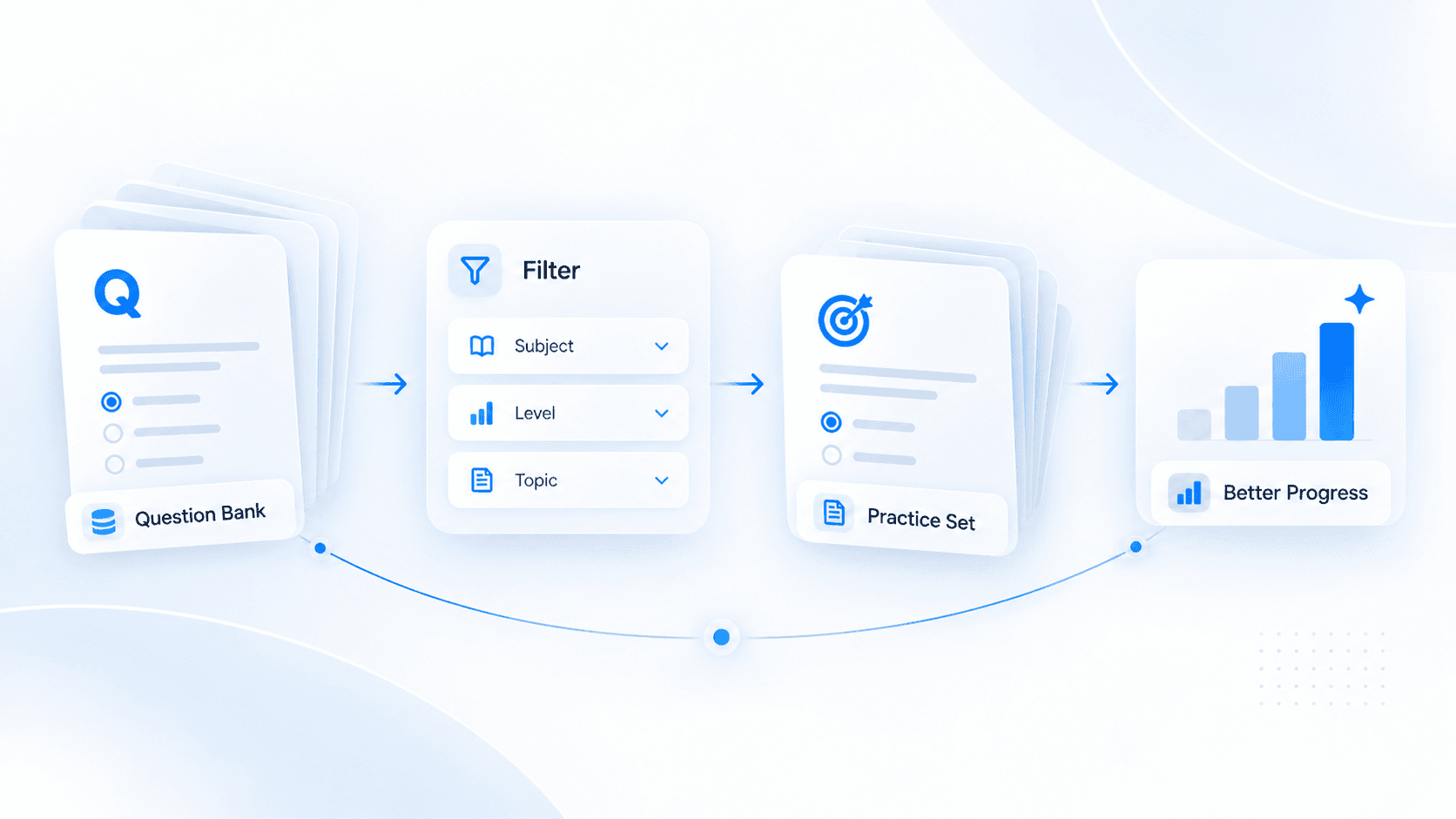
The analysis only matters if it changes what happens next. College Board’s Student Question Bank contains thousands of official questions and can be filtered by section, domain, skill, and difficulty. That makes it useful for converting a diagnostic finding into a focused assignment rather than simply telling a student to 'do more SAT questions.'
For tutoring teams using a structured assignment workflow, Evallo Prepwork can serve the same operational goal: keep practice, assignments, grading, and performance information connected so tutors can act on results rather than manually reconstructing them.
Use a diagnostic-to-practice loop
Diagnose with a full-length or appropriately controlled practice test.
Classify errors by domain, skill, cause, and timing.
Choose one to three priority skills rather than attacking every weakness simultaneously.
Assign targeted practice at an appropriate difficulty level.
Review whether the same error mechanism persists.
Retest under timed conditions and update the plan.
6. Track progress in a way another tutor could understand
In a multi-tutor business, useful analysis should survive a handoff. A note such as 'Math needs work' is almost meaningless. A stronger note records the evidence and the next action: 'Advanced Math errors are concentrated in nonlinear equations; three of five misses were setup errors rather than algebra errors; assign targeted nonlinear-equation set and reassess under time pressure next session.'
This is where the operational side of tutoring matters. A well-structured tutoring CRM should preserve the context needed for follow-up, while the practice system holds the assessment evidence. The goal is not more data entry; it is continuity of instructional decisions.
7. Use official practice tests strategically
College Board provides full-length digital practice tests in Bluebook and also offers downloadable paper practice resources. For students testing digitally, College Board recommends using Bluebook practice to become familiar with the actual digital experience.
Full-length tests are scarce compared with individual practice questions, so tutors should avoid using them merely as homework volume. A full test should answer a diagnostic question: Has the targeted intervention transferred to mixed, timed conditions? Is pacing improving? Are previously weak skills becoming stable when the student does not know what skill is being tested?
How often should a student take a full SAT practice test?
There is no universal interval that works for every student. The right frequency depends on the test date, starting score, available official material, stamina, and whether enough instruction has occurred since the previous diagnostic. In many tutoring programs, the key principle is more important than the calendar: do not retest so quickly that there has been no meaningful opportunity to change the underlying performance.
Between full tests, targeted sets can generate more learning per question. As the official test approaches, full-length simulations become more valuable for validating pacing, endurance, and transfer.
A practical SAT practice-test review template
Review field | What to record |
|---|---|
Test context | Date, test/form, timed conditions, interruptions, accommodations |
Outcome | Total score and section scores |
Domains | Strongest and weakest domains; meaningful changes from prior test |
Error causes | Knowledge, recognition, process, reading, execution, timing, decision |
Pacing | Late guesses, unfinished items, time sinks, module-level deterioration |
Priority skills | One to three skills that should drive the next assignment cycle |
Next assignment | Specific question set, lesson, drill, or review task |
Retest criterion | What evidence would show the intervention worked |
The point of SAT analytics is better teaching decisions
A sophisticated dashboard is not automatically a sophisticated tutoring process. The value comes from connecting evidence to action. The tutor should be able to explain, in plain language, what the test revealed, what will change in instruction, and what evidence will be used to decide whether that change worked.
That principle also applies beyond test prep. Strong tutoring-business systems reduce the distance between what the team learns and what the team does next. For SAT tutoring, a practice test should therefore function as a decision point—not merely a score report.
FAQ
Should tutors review every missed SAT question?
Usually, yes, but not all misses deserve equal instructional time. The objective is to identify patterns and causes, then prioritize the errors most likely to recur or unlock broader improvement.
Should students repeat the same SAT practice test?
Repeating a test can be useful for reviewing process or confidence, but the resulting score is not a clean measure of new performance because the student has prior exposure. Use fresh material when you need a stronger diagnostic comparison.
What is the most useful SAT metric besides the total score?
There is no single best metric. For instruction, domain and skill patterns combined with error cause and timing are usually more actionable than a single aggregate number.
Can tutors build targeted sets from official SAT questions?
College Board’s Student Question Bank allows filtering official questions by assessment, section, domain, skill, and difficulty, which makes it useful for targeted follow-up practice.
Other Stories