Enhanced PreACT 2026: Changes Tutors Need to Know | Evallo


Enhanced PreACT 2026: What Tutors Need to Change This Fall
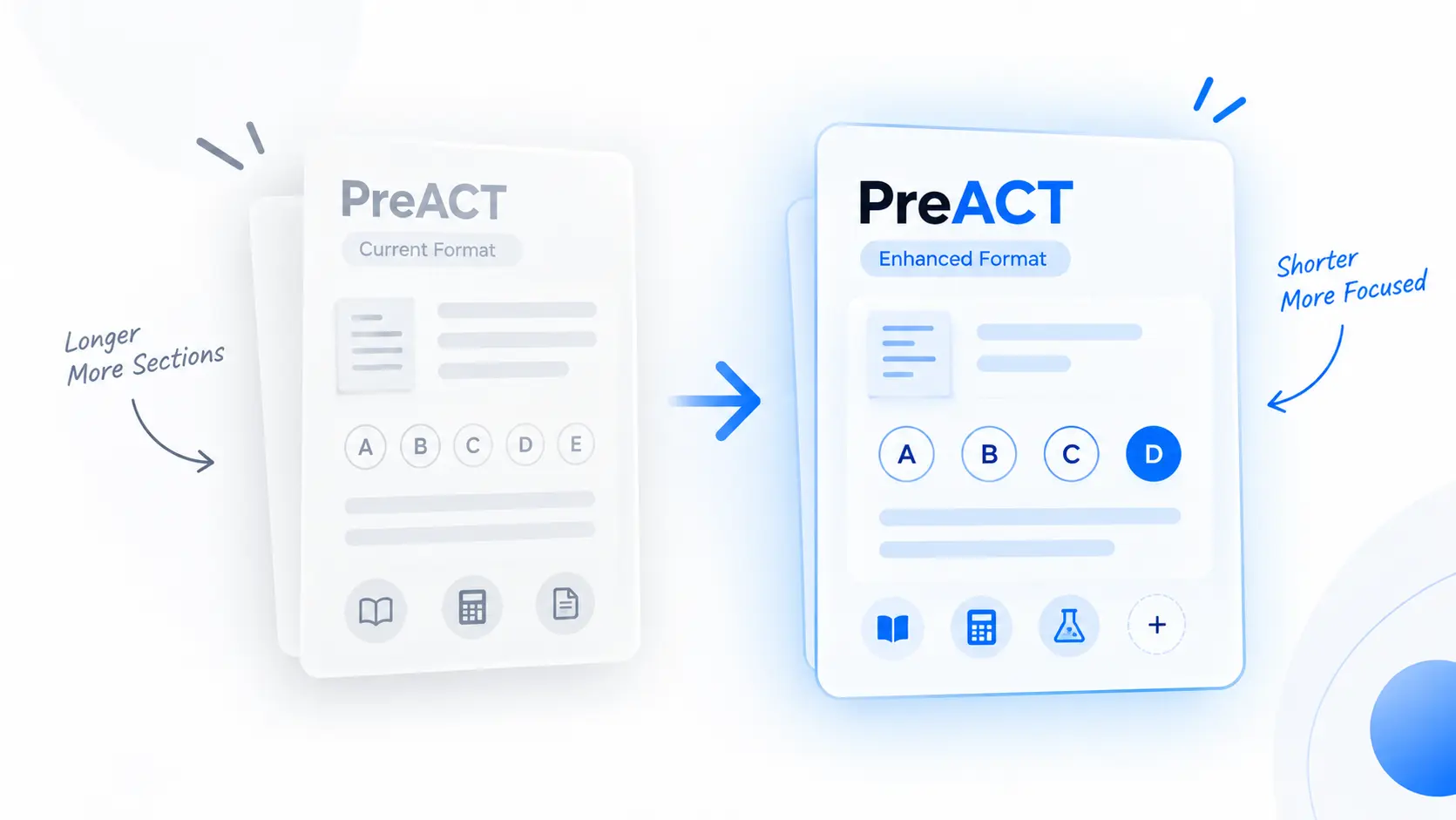
The enhanced PreACT is arriving in fall 2026, and ACT tutors should treat it as more than a cosmetic refresh. ACT says the standard PreACT will move to a new blueprint, its Composite will be calculated from English, Math, and Reading, science will become optional at the school or district level, English and Reading passages will be shorter, and Math will move from five answer choices to four. The practical consequence: diagnostics, homework, mock tests, score explanations, and curriculum pacing should now align with the enhanced ACT family of assessments.
Enhanced PreACT 2026: The Changes at a Glance
Area | What changes | What tutors should do |
|---|---|---|
Launch | PreACT new blueprint launches in fall 2026 | Retire legacy-format assumptions from fall diagnostics and planning. |
English & Reading | Shorter passages | Use current-format passage sets and recalibrate pacing expectations. |
Math | Four answer choices instead of five | Update mock-test design and eliminate five-choice legacy items when simulating format. |
Composite | English + Math + Reading | Explain that science no longer determines the Composite. |
Science | Optional at school/district contract level | Confirm the student’s school testing configuration before building the prep plan. |
Score scale | PreACT score scales remain aligned to ACT | Keep score conversations connected to ACT readiness, but use the new Composite logic. |
ACT’s official Enhanced PreACT overview lists the fall 2026 rollout and these structural changes. ACT also says PreACT 9 Secure and PreACT Secure moved to their new blueprints in spring 2026, while the PreACT 8/9 blueprint launch remains to be announced.
Why the PreACT Change Matters to Private ACT Tutors
PreACT is often used as an early readiness signal. Even when a private tutor is not administering the school’s PreACT, families may arrive with a score report and ask what it means for future ACT preparation. If the tutor interprets that report using the old four-subject Composite model or assigns legacy-format practice as if nothing changed, the student receives a distorted picture of the current test.
The change also matters because PreACT and ACT are becoming more structurally coherent. A student can now move from an enhanced PreACT experience into an enhanced ACT prep program without relearning basic format expectations.
1. Update Your Score Conversations: Science Is No Longer in the Composite
The most important scoring change is simple: the enhanced PreACT Composite is based on English, Math, and Reading. ACT says all PreACT assessments will implement that E+M+R Composite by fall 2026. Science can still produce useful information when it is administered, but it should not be described as part of the Composite calculation.
This mirrors the enhanced ACT. ACT’s K–12 enhanced ACT FAQ states that all ACT programs moved to the English-Math-Reading Composite beginning in September 2025, while science remains separately reported when taken.
What to say to families
A clean explanation is: “Your Composite now reflects English, Math, and Reading. If your school administers Science, that score still tells us something useful about scientific reasoning, but it does not raise or lower the Composite.”
2. Confirm Whether the Student Will Actually Take Science
For PreACT, science optionality is not an individual student choice. ACT specifies that the school or district chooses whether science is included. That makes one question newly important during intake: Which PreACT configuration is your school administering?
Ask whether Science is included in the school’s PreACT administration.
Do not assume two students in different districts are taking identical configurations.
If Science is included, prepare it as a separate skill and reporting area rather than as a Composite-score lever.
If the family is ultimately preparing for the ACT, discuss separately whether taking ACT Science makes sense for the student’s goals and target institutions.
3. Rebuild PreACT Practice Around the New Format
Format familiarity matters most when practice resembles the assessment the student will actually see. For fall 2026 PreACT students, that means shorter English and Reading passages and four-option Math items. Tutors do not need to discard every legacy question—the underlying skills remain useful—but legacy material should no longer be presented as a faithful simulation of the current format.
ACT makes a similar distinction for the enhanced ACT: its educator FAQ says the concepts and skills remain broadly consistent, while question structure and the distribution of reporting categories have changed. Tutors can therefore reuse strong skill practice while updating full-length simulation. ACT’s free ACT practice resources are a useful first-party reference for current-format expectations.
4. Recalibrate Pacing Instead of Reusing Legacy Benchmarks
Shorter passages and fewer answer choices change the texture of a timed section. A pacing rule built from an older form may still be directionally helpful, but it should not be treated as a precise benchmark for the enhanced assessment. Run current-format diagnostics, measure the student’s actual time by question or passage, and set pacing targets from observed performance.
A testing workflow that records timing and section-level performance can make this easier. Evallo Prepwork supports ACT assignments, detailed score reports, progress tracking, question-level time tracking, and custom uploaded material, so tutors can separate “content weakness” from “pacing weakness” instead of relying on a single total score.
5. Audit Your ACT Curriculum for Enhanced-Format Drift
Many tutoring businesses have years of ACT and PreACT material. The risk is not that old questions suddenly become academically worthless; it is that a mixed library quietly teaches outdated test behavior. A short content audit is worth doing now.
Label legacy-format material clearly.
Prioritize current-format sets for diagnostics and timed simulations.
Check Math items for four-choice formatting when the goal is test simulation.
Check English and Reading sets for passage structure and pacing assumptions.
Update score-report templates so the Composite explanation uses English, Math, and Reading.
Train tutors on the difference between student-level ACT Science choice and school/district-level PreACT Science configuration.
For teams maintaining proprietary material, how a tutoring business can systematize curriculum and progress tracking can help keep custom practice, grading, timing, and reporting in one system rather than scattering revised forms across PDFs and spreadsheets.
6. Use PreACT as a Diagnostic Bridge—not a Final ACT Prediction
ACT states that PreACT score scales remain aligned to ACT and that PreACT remains predictive of ACT scores. That makes the assessment useful for early planning. But tutors should avoid treating one PreACT result as destiny. A score is a snapshot taken under a particular blueprint, testing environment, preparation level, and point in the student’s academic development.
The stronger use is diagnostic: identify the sections and skills that deserve attention, compare them with school performance and later practice tests, then update the plan as new evidence arrives.
A 30-Minute PreACT 2026 Readiness Audit for Tutoring Businesses
5 minutes — Check every public webpage, handout, and sales deck that describes the PreACT Composite.
5 minutes — Review diagnostic and mock-test formats for legacy five-choice Math or outdated passage assumptions.
5 minutes — Update intake forms to ask whether the school administers PreACT Science.
5 minutes — Review score-report language and tutor scripts.
5 minutes — Identify which current-format official resources your tutors should use as references.
5 minutes — Assign one owner to keep ACT/PreACT format changes synchronized across curriculum, tutor training, and client communication.
How This Fits the Broader Enhanced ACT Transition
The PreACT rollout is the latest stage of a larger ACT transition. ACT’s educator overview of the enhanced ACT and PreACT says state and district ACT administrations moved to the enhanced format beginning in spring 2026. The standard PreACT follows in fall 2026. For tutoring businesses, this is the point at which “enhanced ACT” should stop being treated as a special update and become the default operating assumption for new curriculum and student plans.
If your team still needs a broader refresher, Evallo’s guide to the enhanced ACT covers the larger exam transition, while the online tutoring ecosystem guide can help map curriculum cycles to upcoming national administrations.
FAQ: Enhanced PreACT 2026
When does the enhanced PreACT start?
ACT says the standard PreACT launches its new blueprint in fall 2026. PreACT 9 Secure and PreACT Secure launched new blueprints in spring 2026. The PreACT 8/9 blueprint launch is still listed as TBD.
Is Science optional on the PreACT in 2026?
Yes, but the choice is made at the school or district contract level, not by each individual student.
How is the new PreACT Composite calculated?
The enhanced PreACT Composite is calculated from English, Math, and Reading. Science is not part of that Composite.
Does PreACT Math have four answer choices now?
ACT lists a reduction from five Math answer choices to four as part of the enhanced PreACT changes.
Can tutors still use older PreACT or ACT questions?
Yes for skill practice when the content is still relevant. But legacy questions should be clearly labeled and should not be used as a faithful full-format simulation when their structure differs from the enhanced test.
Bottom Line for ACT Tutors
The enhanced PreACT is now part of the fall 2026 testing landscape. The tutor checklist is straightforward: use the English-Math-Reading Composite, verify whether the school includes Science, update Math and passage-format simulations, recalibrate pacing with current-format diagnostics, and audit old curriculum before it reaches students. The underlying academic skills still matter. The operating assumptions around the assessment have changed.
Other Stories